Generalizable robot policies typically rely on robot
demonstrations with action annotations, yet such data are
expensive to collect and difficult to scale. In contrast,
large-scale and readily available human videos record rich
physical interactions, but lack action annotations that can be
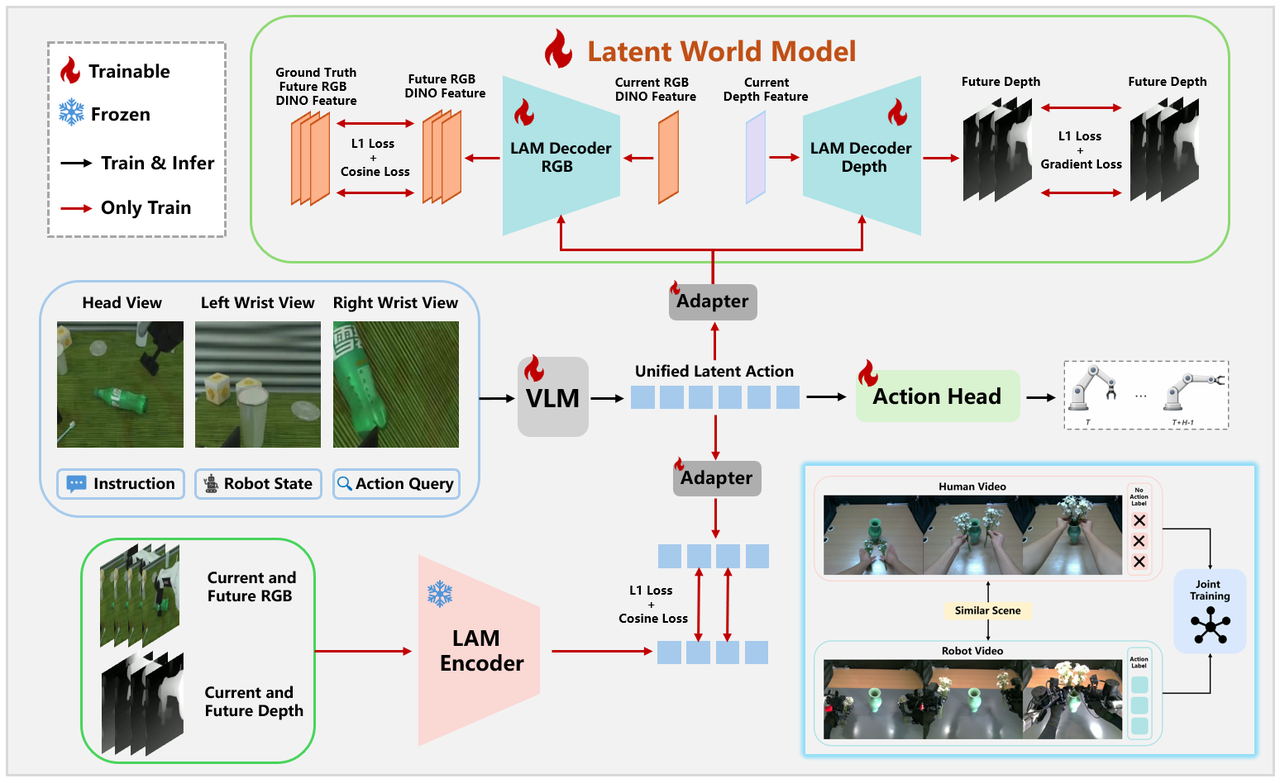
directly used for robot control. We present WALA, a framework
that jointly learns executable latent actions from action-labeled
demonstrations and action-free videos.
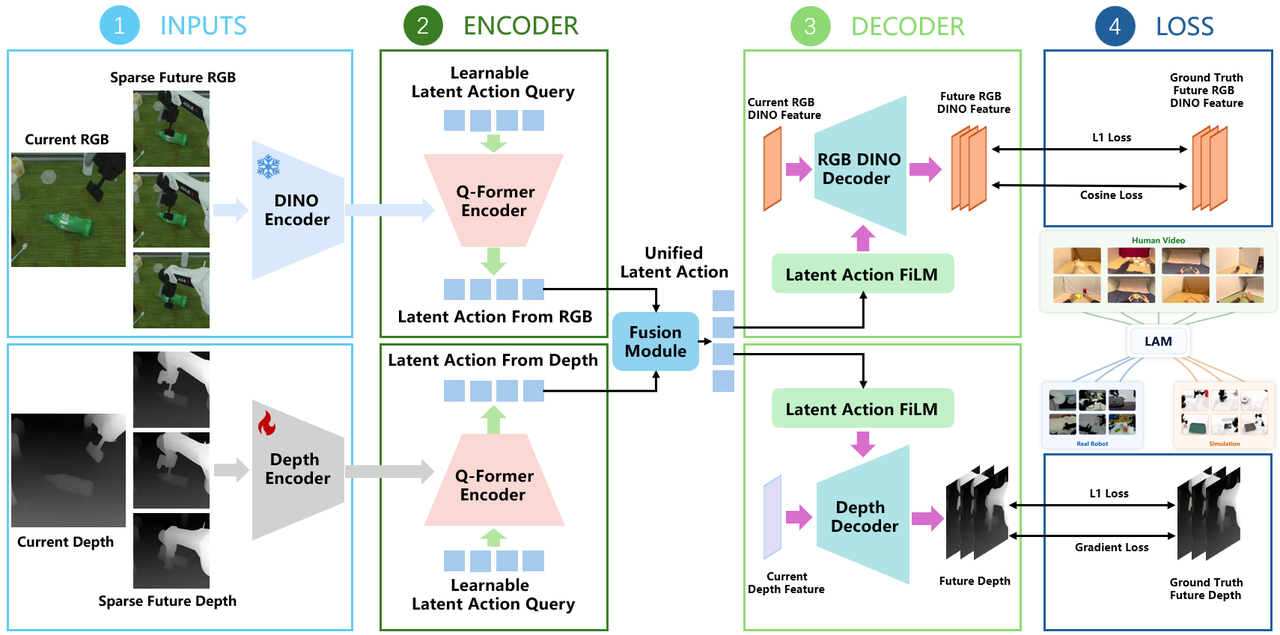
WALA first pretrains a semantic-geometric latent action model on
videos without action annotations, enabling it to learn
action-relevant representations from scene evolution between the
current observation and multiple sparsely sampled future
observations. Specifically, WALA forms semantic and geometric
future deltas, from which the encoder extracts latent action
targets, while the decoder predicts future deltas in the DINOv3
feature space and dense depth space. This avoids raw pixel
reconstruction, reducing the influence of appearance details
while preserving task-relevant semantic and geometric structure.
During policy training, the pretrained encoder remains frozen to
provide stable latent action targets, while the decoder serves as
a trainable latent world model. The latent actions generated by
the vision-language backbone are jointly supervised by robot action
prediction, latent action target matching, and future dynamics
prediction. Action-labeled demonstrations provide both
executable control and dynamics supervision, whereas action-free
videos require no robot action labels and still participate in
training through latent action and future dynamics supervision. In
this way, WALA connects physical scene evolution in videos with
executable robot control.
Experiments show that WALA achieves strong performance on
RoboTwin and reaches an average success rate of 75.2% on
RoboCasa, setting a new state-of-the-art result. Additional
real-robot experiments further evaluate its generalization
ability across diverse manipulation tasks.